A graph backend for scientific pipelines
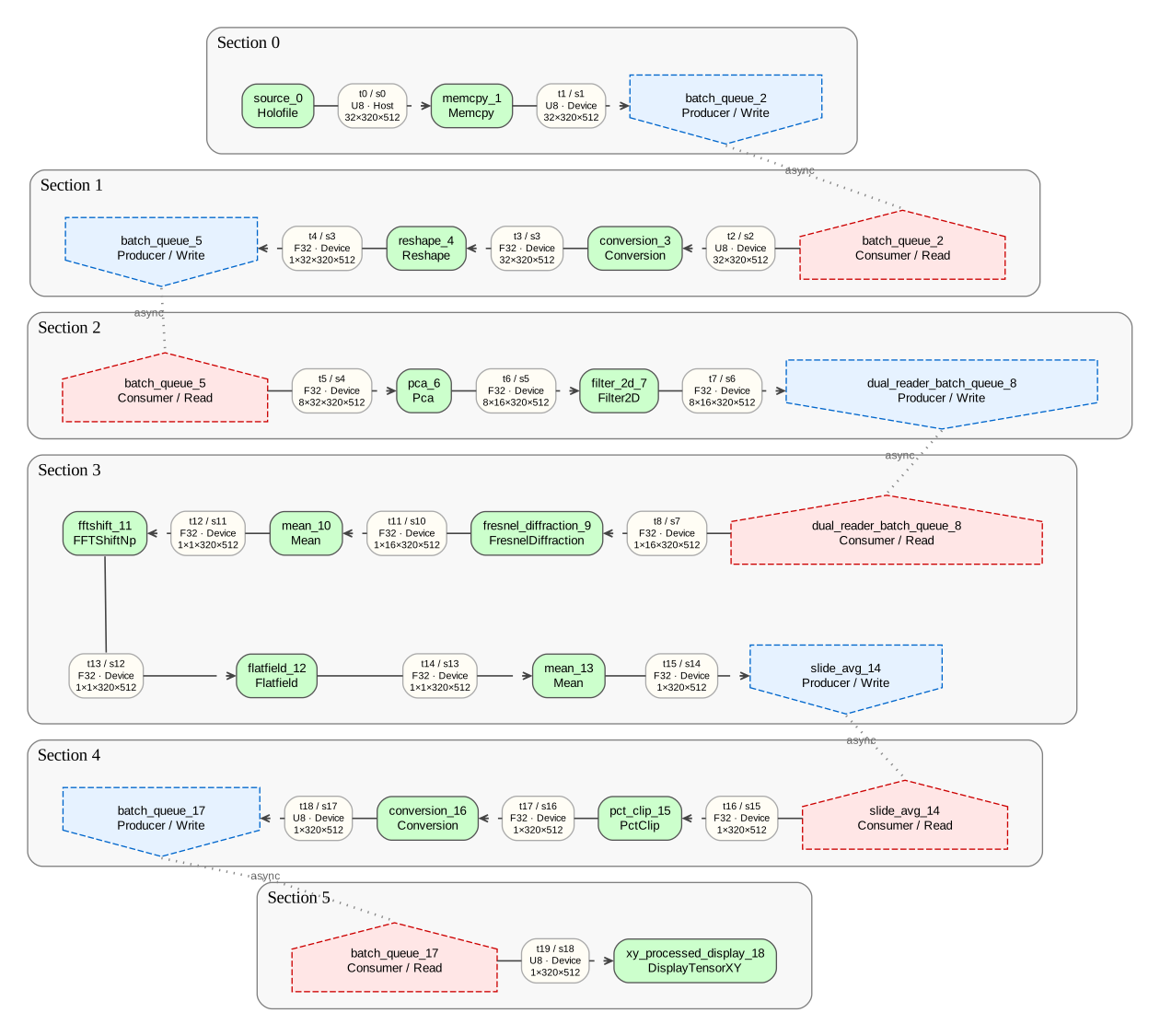
Describe the computation as connected tasks. Holoflow compiles the graph, manages tensor lifetimes and memory, then schedules CPU and GPU work while the algorithm remains readable.1
Understand the runtimeThe Holoflow project
Holoflow is an open-source C++ and CUDA stack for describing, running, and exploring high-throughput scientific imaging pipelines. Holovibes brings the stack into the lab through an interactive Qt application.
Experiments and engineering
One stack connects the processing model, the GPU runtime, and the measurements seen in the lab.
Describe the computation as connected tasks. Holoflow compiles the graph, manages tensor lifetimes and memory, then schedules CPU and GPU work while the algorithm remains readable.1
Understand the runtimeTransform high-rate interferometric acquisitions into live views of retinal blood flow, with reconstruction and visualization performed as the data arrives.12
Reproduce the experimentUse the same modular processing foundation to explore depth-resolved Doppler measurements and evolve experimental pipelines without rebuilding the application around each method.
Open the application guideInspect wavefront quality as the experiment runs, including Shack–Hartmann measurements and Zernike modes used to understand and correct optical aberrations.
Open the application guideCombine off-axis holography, aberration correction, and phase unwrapping to reconstruct three-dimensional sample volumes from tomographic acquisitions.
Open the application guideOne project, several layers
Start with the application or work directly with the runtime and its infrastructure libraries.
Acquire, reconstruct, analyze, and visualize holographic data interactively.
Explore Holovibes Execution runtimeCompile declarative processing graphs into predictable CPU and GPU execution.
Explore HoloflowRAII wrappers for CUDA resources and companion libraries.
Explore Curaii Acquisition formatHigh-throughput reading and writing of holographic recordings.
Explore Holofile
Supporting libraries: holotask for reusable operators,
holonp for numerical primitives, and holoflow_event
for runtime communication.
Built by


Where to begin
L. Puyo, M. Paques, M. Fink, J.-A. Sahel, and M. Atlan, “In vivo laser Doppler holography of the human retina,” Biomedical Optics Express, vol. 9, no. 9, pp. 4113–4129, 2018. https://doi.org/10.1364/BOE.9.004113. See also the site-wide reference. ↩
M. Atlan, Doppler Holography Measurements of the Eye Fundus in a Volunteer – May 27, 2025 [Data set]. Zenodo, 2025. https://doi.org/10.5281/zenodo.16761111. Licensed under CC BY 4.0. See also the site-wide reference. ↩